
Popcorn Ceiling Repair After Wall Removal: Where Should the Finish Stop?
Updated October 25, 2026
Removing a wall joins the rooms but can leave a ceiling strip, mismatched texture or a change in height. Decide what needs repair and where a consistent finish should end.
- Trusted since 2005
- Fully insured
- Dust-controlled sanding
- Paint-ready finishing
- 3-year workmanship warranty
Quick Answer
A narrow ceiling strip can sometimes be repaired and blended into sound popcorn texture after the wall-removal work is complete and approved. If the adjoining textures differ, the ceiling planes do not line up, or you want one continuous smooth finish, compare a broader refinishing scope. Establish structural and service requirements first; decorative compound is not a structural repair.
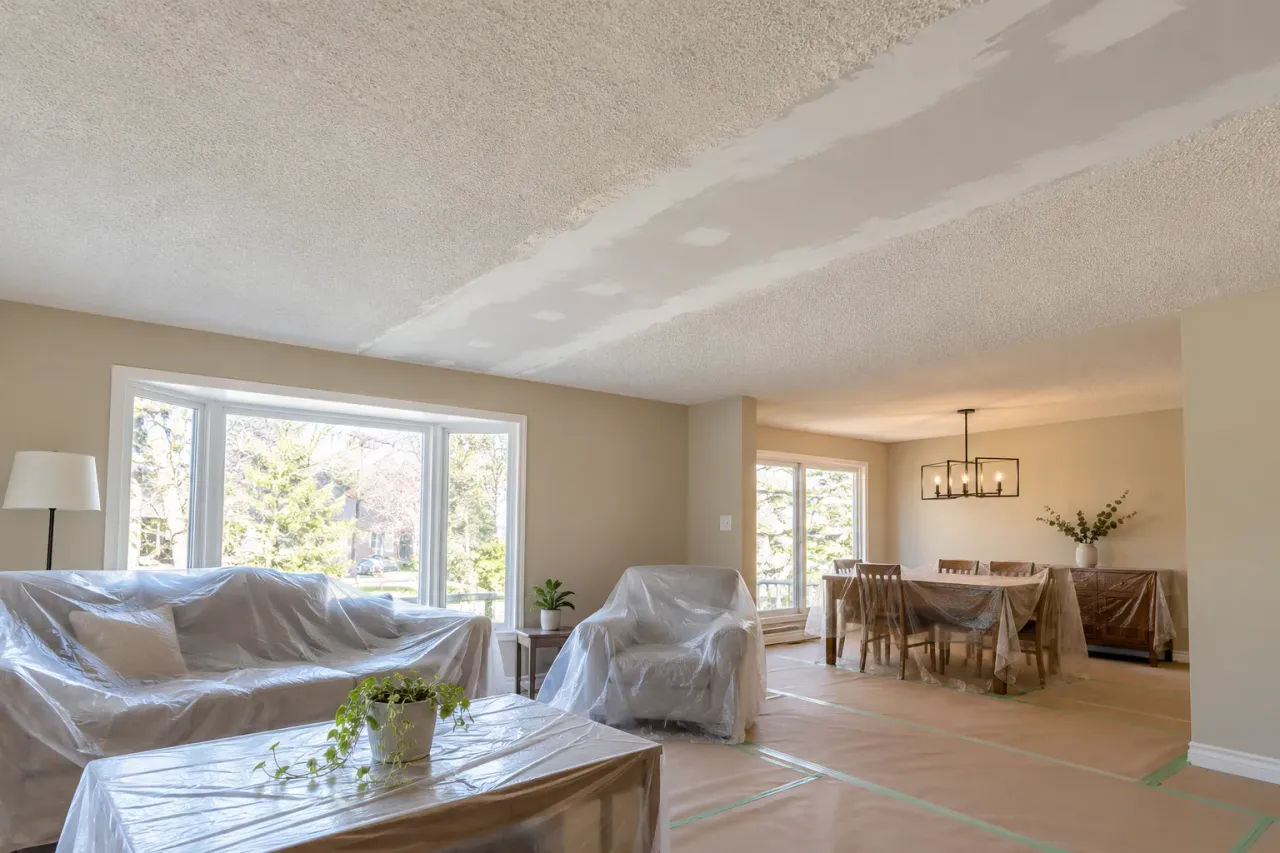
Popcorn ceiling repair after wall removal is partly a patching job and partly a decision about the whole room. Once a divider is gone, two ceilings that used to be viewed separately become one long sightline. A narrow untextured strip may be the most obvious problem, but different texture, paint colour, ceiling height or old repair work can matter just as much. Decide where the finished surface should stop before comparing prices.
EPF Pro Services provides popcorn ceiling removal and smooth ceiling refinishing for homeowners who want a consistent result beyond the demolition stage. This guide explains when a local texture repair is reasonable, when broader refinishing deserves consideration, and what must be settled by the renovation team before cosmetic ceiling work begins. It is not a guide to removing a wall or changing structural support.
Identify what the removed wall has revealed
| Visible condition | Decision to discuss | What finishing cannot assume |
|---|---|---|
| Narrow gap with similar sound texture on both sides | Supported repair and a texture blend | That the original texture can be matched exactly |
| Different textures or paint histories | Refinish one continuous plane or retain a deliberate boundary | That paint alone will unify the surfaces |
| A ridge, step or sag across the former wall line | Assess construction and plane alignment | That a thick coat of compound is an appropriate correction |
| Beam or bulkhead remains | Finish separate planes with clear stopping points | That the beam can be hidden or altered cosmetically |
Photograph the room from both ends rather than sending only a close-up of the gap. A wide view shows whether the old wall line crosses a window's light, meets a kitchen cabinet or runs into a hallway. Those relationships help define the finish area. The size of the opening is important, but it is not always the size of the surface that needs attention.
Finish planning starts after the structural questions
The renovation contractor and appropriate qualified professionals must establish that the wall-removal work, required support and relevant checks are complete before the ceiling is closed. Do not ask a finishing contractor to infer structural adequacy from the appearance of a gap. A decorative patch does not replace framing, an engineered detail or the inspections applicable to the renovation.
The same principle applies to services. Electrical, plumbing or ventilation changes need to be completed and released for closure by the responsible trades. Confirm whether an access point must remain available. Closing the ceiling too early can mean cutting through a new repair to finish work that should have happened first. Keep the trade responsibilities clear even if one company coordinates the whole renovation.
If a new beam or bulkhead remains, include its faces, corners and junctions in the finishing scope. The new surface may create a useful visual break between rooms, but its dimensions and position are not decorative choices for the drywall finisher alone. Discuss the appearance only within the approved construction. This lets the final design work with the building rather than promise a flat ceiling where one is not feasible.
Check older coatings before disturbing the edges
Texture repair and full removal both disturb existing material. Uncertain older ceilings need an appropriate material assessment before scraping, sanding or cutting. Health Canada's asbestos guidance recommends professional testing before renovating potentially affected material and qualified specialist handling where asbestos is identified. Do not use a neighbour's renovation or a building date alone as clearance for your ceiling.
Share any existing assessment with the finishing contractor and confirm that it covers the surfaces being worked on. A new drywall strip does not make the old material beside it safe to disturb. Ordinary HEPA-assisted finishing is useful for controlling renovation dust, but it is not a substitute for the procedures required for hazardous materials. Resolve that question before choosing a sample patch or removal method.
Moisture damage and unexpected movement also need attention first. If the ceiling has old stains, loose material or a crack that is changing, include those observations in the assessment. A new open room can make a pre-existing problem easier to notice. It should not automatically be attributed to the wall-removal work or hidden beneath a broader skim coat.
When a local popcorn texture repair can make sense
A local repair is most promising when the surrounding ceiling is sound, the two sides have similar texture and the homeowner wants to keep the textured appearance. The opening still needs a properly supported closure and suitable joint treatment. After that, the contractor can assess a texture blend and the painting needed to make the area reasonably consistent.
Matching texture involves more than choosing a similar pattern. Existing material may have several coats of paint, softened peaks, uneven density or a previous repair hidden in the field. New texture can look different even if its colour is close. Ask what level of blend is realistic and whether a sample can be reviewed after the necessary safety and preparation checks.
The finish area will generally be wider than the bare strip. Joints need room to be feathered and blended into the surrounding surface. If the quote prices only the visible opening, clarify how the transitions are included. A very narrow raised band can catch light from the far side of the room even when the individual texture particles look similar.
Accept the right tradeoff for a retained texture
Keeping popcorn can limit the overall renovation work, but it may leave some visible difference where the repair meets the old ceiling. That may be acceptable in a less prominent area. It is less attractive when the former wall line sits across the main view from the entry or dining table. Agree on that expectation before approving a local repair as the final solution.
When one continuous smooth finish is worth comparing
Broader refinishing becomes more compelling when two rooms have clearly different textures, the ceiling contains several old repairs, or the goal of the renovation is a unified open space. Removing suitable existing texture and refinishing the continuous area can address the visual mismatch together. It also lets the contractor review the exposed substrate across the room instead of treating each defect as an isolated patch.
This does not mean every wall removal requires the entire main floor to be refinished. The useful boundary may be a room perimeter, a bulkhead, a change in ceiling height or a doorway. Walk the proposed boundary with the contractor and look from normal seating positions. An arbitrary line halfway across a continuous ceiling often remains noticeable after painting, while a real architectural break can make the scope feel intentional.
Painted popcorn changes the method discussion. Texture that has been sealed by paint may resist removal and expose more substrate damage if forced. Our painted popcorn removal and skim-coat guide explains the broader options. The chosen method still has to suit the actual material, condition and intended result in your connected rooms.
A smooth finish also changes what you notice. Coarse texture can distract from surface variations, while a smooth ceiling can reveal ridges and shallow waves under daylight. Budget for appropriate repair and refinishing rather than assuming that removal is the entire improvement. The endpoint should describe the prepared, primed or painted ceiling you want to receive.
A height difference is a separate problem from texture
Two ceiling areas may not meet in the same plane. Differences in construction, board thickness, old overlays or an intentional step can become obvious once the wall no longer separates them. Compound can refine a transition, but it should not be treated as an unlimited material for concealing any change in height. The contractor needs to establish why the difference exists and which correction is appropriate.
Sometimes the sensible result is a deliberate transition, such as finishing the sides of an approved bulkhead cleanly. Other projects may justify a separately planned ceiling assembly to create a different plane. That has implications for headroom, lights, cabinets, vents and access. Compare the full assembly and its interfaces before deciding that new board is a simple cosmetic shortcut.
Our drywall repair and ceiling patching services can be scoped around sound, properly supported material and the agreed renovation details. The finishing quote should identify what is being repaired and what belongs to the structural or service work. This prevents a promise of seamless decoration from being mistaken for a solution to a construction problem.
Coordinate lights, cabinets and the finishing sequence
New lighting often accompanies an open-room renovation. Have the electrician confirm fixture locations and complete the relevant work before the final ceiling finish. Long rows of downlights or light directed across the ceiling can reveal transitions that were less noticeable under the previous lighting. Tell the finisher about the intended fixtures even if they are not installed yet.
Cabinets, crown moulding and curtain tracks can also define or obstruct the ceiling edge. Clarify which items remain, which are being replaced and which trade handles removal or reinstatement. A new kitchen cabinet should not be treated as a convenient surface for taping protection without considering its finish. Access and protection need to be designed around the actual room.
The ceiling-removal renovation sequence guide helps place this work among other trades. Agree on a practical handoff: the opening is released for closure, the repair and smoothing are completed, primer reveals remaining corrections, and the specified final painting follows. Keep those stages visible in the schedule instead of compressing them into a single vague finishing day.
Comparing a patch with full refinishing? Send wide photos from both sides of the former wall, the proposed finish boundary and details of the completed renovation work through our ceiling repair and refinishing quote form. Include any remaining lighting or cabinet work.
Compare prices using the same finished area
For a local texture repair, ask what closure, joint treatment, texture blending, primer and painting are included. For a smooth ceiling, ask about removal or surface preparation, repairs, skim coats, sanding, primer inspection and finish paint. These are different packages. A lower figure may be entirely reasonable for a smaller endpoint, but it should not be mistaken for the same finished result.
Separate the repair dimensions from the decoration dimensions. A narrow strip may need a broader feathered area, and the painted section may extend farther again to reach a natural boundary. Room height, furnishings, stairs and the route for debris affect setup. Identifying these areas on a sketch makes the quote easier to understand than one square-foot number without context.
Also ask how unexpected conditions are handled. Removing texture can reveal failed joints or older patches that were not visible during the first visit. A sensible process records the finding, explains the proposed change and confirms the revised scope before extra work proceeds. Do not assume every concealed defect is included, and do not accept an undefined allowance that leaves the final result unclear.
Allow drying and dust control to shape the schedule
An open living and dining area can be harder to isolate than a room with a door. Plan how the household will move around the work zone and which furniture can be cleared. Protection should cover the work area and the route used by the crew. No one should need to move equipment or step beneath overhead work to reach another room.
EPF uses dust-controlled sanding with HEPA vacuum systems where appropriate, together with protection and cleanup. These measures reduce ordinary finishing dust but do not make renovation completely dust-free. Discuss whether the connected spaces can remain in normal use during each stage. It is better to plan around the full finishing sequence than to assume the disruption ends when the patch is installed.
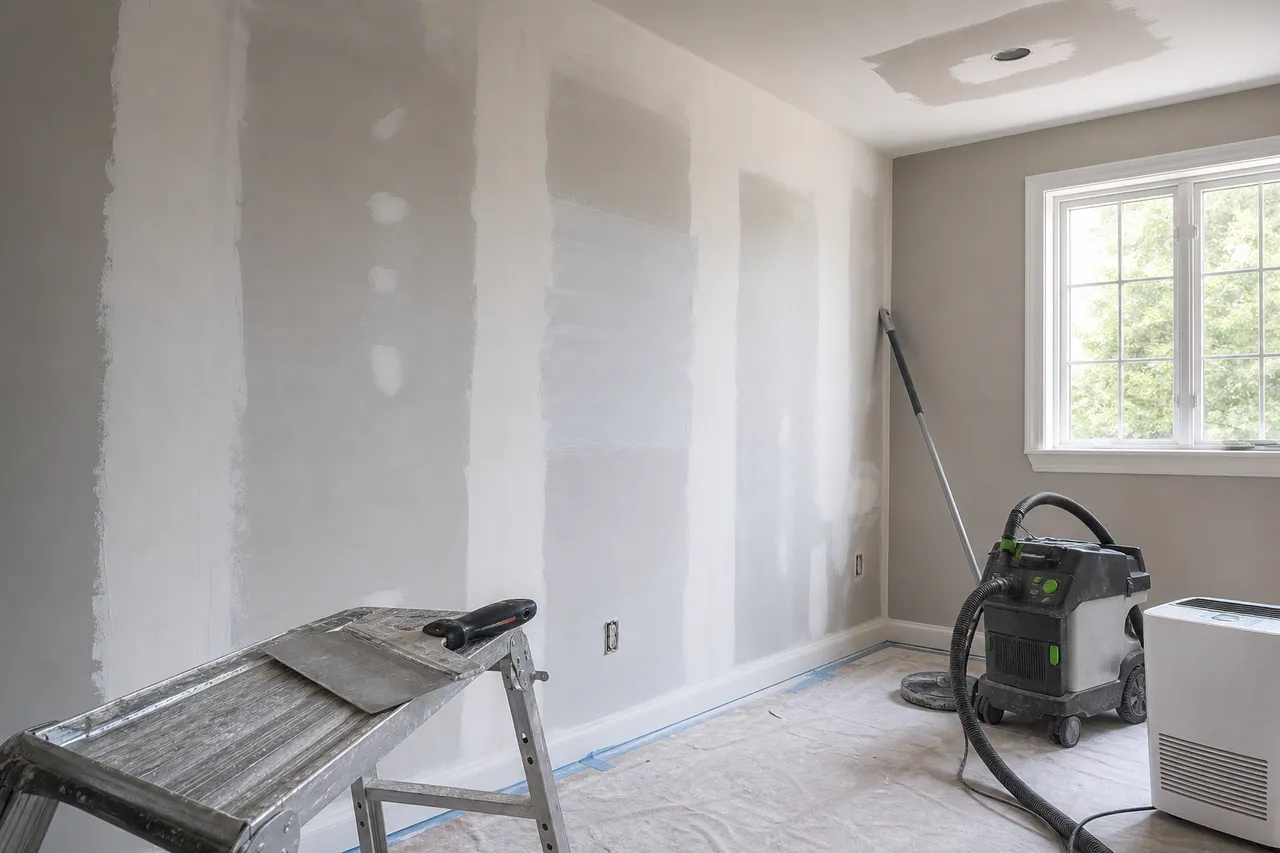
Joint treatment and skim coats need appropriate drying before sanding, primer and subsequent coatings. The schedule depends on the selected products, thickness and room conditions. Several short visits can be part of a careful result. Ask for the expected sequence and what would change it rather than relying on a universal promise that every open-room ceiling can be completed in one day.
Planning help across the four service areas
For homeowners arranging popcorn ceiling removal in Burlington, a connected living and dining ceiling is a useful reason to compare local texture repair with one continuous finish. Send views from both rooms and identify where you want the work to stop. The choice follows the ceiling condition and your goals, not a rule that every open-plan renovation needs the same treatment.
For Mississauga ceiling removal and refinishing, mention whether the project is in a house or condo and whether building coordination is required. For Oakville smooth-ceiling projects, show the windows and planned lighting so finish expectations are discussed in the light that will reveal the work. These are project details worth recording in any city, not claims about all homes in those locations.
For Hamilton popcorn ceiling removal, tell us about any known plaster, drywall overlays or previous ceiling repairs before a method is chosen. An older or mixed surface deserves assessment wherever it is located. All four city services connect to the same practical goal: a scope that explains the base material, repair boundary and finished appearance.
Inspect the transition before final painting
At the appropriate stage, review the former wall line from normal standing and seated positions. Look for a raised band, rough edge, uneven texture density or a mismatch between adjoining planes. Check the perimeter and any retained bulkhead as well. Use a location-based list so each item can be evaluated against the agreed scope rather than discussed as a general feeling that the room looks wrong.
Primer can make remaining pinholes, sanding marks and surface differences easier to see before the finish coats. Our smooth ceiling inspection checklist provides a practical review sequence. Flat paint can reduce distracting reflection, but it cannot correct a raised repair or loose substrate. The surface needs to be ready before decoration is expected to unify it.
Send photos that show the whole decision
Include the complete connected room, both ends of the former wall, a closer view of the exposed strip, ceiling height and approximate room dimensions. State whether the popcorn has been painted and whether the intended result is retained texture or a smooth finish. Explain what structural and service work has been completed and what remains with other trades. Share any material-assessment information already available.
EPF Pro Services can then discuss a local patch, a broader refinishing area or the need for further assessment before quoting. You do not need to decide the technique from a photo yourself. Start with the finish you want and the room you have. Request an estimate for ceiling repair after wall removal with those details so the proposal describes a complete, understandable result.
FAQ
Can the ceiling strip be patched without removing all the popcorn?
Sometimes, if the surrounding material is sound and retaining texture suits the room. A supported repair and texture blend may work, but an exact match should not be assumed.
Will paint hide different popcorn textures?
Paint can improve colour consistency, but it does not remove differences in texture density, height or a raised patch edge.
Do adjoining ceilings have to be refinished together?
Not always. Compare the sightlines and natural boundaries. A continuous ceiling may benefit from broader refinishing, while a bulkhead or level change can provide a sensible stopping point.
Can compound fix a ceiling height difference after wall removal?
The cause and size of the difference need assessment. Finishing compound is not a structural repair or a universal way to correct mismatched ceiling planes.
When should ceiling finishing happen in the renovation?
After the relevant structural and service work is complete and released for closure, with lighting locations and retained finishes agreed. Allow the required drying and inspection stages before final paint.
Related local pages and guides
Keep Planning Your Project
Planning illustrations
The repair boundary and the finished room

Article Review
AuthorEPF Pro Services
Reviewed byEPF Pro Services
UpdatedOctober 25, 2026
Ready to plan your ceilings?
Get a popcorn ceiling quote today
Share photos, ceiling heights, and timing. We reply the same day with Mississauga, Oakville, and GTA availability.
Quick next step