
What Should a Drywall Repair Quote Include? A Homeowner’s Contractor Checklist
Updated July 19, 2026
A practical checklist for comparing drywall repair estimates by scope, finish quality, visits, dust control, painting, cleanup, and warranty.
- Trusted since 2005
- Fully insured
- Dust-controlled sanding
- Paint-ready finishing
- 3-year workmanship warranty
Quick Answer
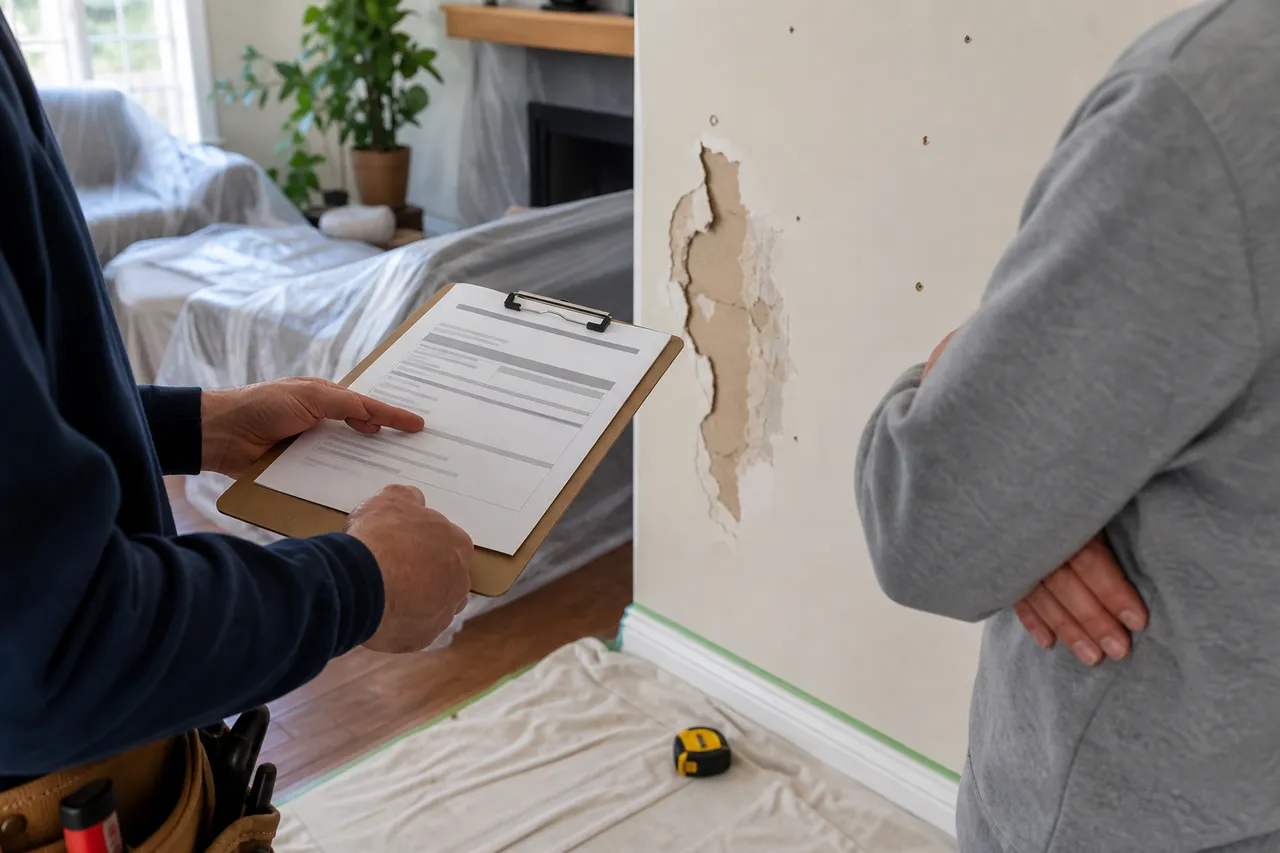
A proper drywall repair quote should identify the damage, repair method, room protection, materials, taping and compound work, drying and return visits, sanding and dust control, primer or paint, texture matching, cleanup, schedule, exclusions, and workmanship warranty. Compare the written scope—not only the total—because a patch-only estimate and a complete paint-ready repair are different jobs.
A drywall repair quote should tell you what will happen from the first cut to the final cleanup. It should describe the damaged area, the proposed repair, how the room will be protected, whether new board and backing are needed, how tape and joint compound will be applied, how drying and return visits are handled, what sanding and dust control are included, and whether the result is left unfinished, primer-ready, or fully painted. If those details are missing, two prices cannot be compared fairly.
EPF’s drywall repair services are scoped around the final condition the homeowner needs, not just the size of the hole. That distinction matters when a repair sits on a ceiling, long wall, stairwell, or other surface where daylight makes poor finishing visible.
Drywall repair quote checklist at a glance
| Quote item | What a complete scope explains | Why it matters |
|---|---|---|
| Assessment | Location, size, cause, substrate condition, and visible related damage | The repair method depends on more than hole dimensions. |
| Protection | Floors, furniture, doorways, vents, fixtures, and traffic paths | Occupied rooms need setup and containment. |
| Repair work | Cut-out, backing, board, fasteners, tape, corner bead, and compound coats | A supported repair lasts better than filler over a weak opening. |
| Finish | Sanding, dust control, primer, texture matching, and paint | Paint-ready and patched are not the same endpoint. |
| Logistics | Materials, visits, drying allowances, cleanup, disposal, exclusions, and warranty | These details often explain the price difference. |
Start with the damage assessment, not a square-foot number
A quote should identify whether the problem is a dent, fastener pop, failed tape joint, access opening, corner-bead failure, ceiling crack, or water-damaged section. It should also state important assumptions. A photo may show a stain but cannot prove the drywall behind it is dry and firm. A wall opening may look small while loose board or an unsupported edge extends beyond the visible damage.
The cause matters. A plumber’s access hole can usually be closed after the plumbing is confirmed complete. A recurring ceiling stain cannot be responsibly repaired until the leak is stopped and the cavity is dry. Repeated diagonal cracking, widespread movement, suspected mold, or a soft ceiling can require inspection beyond cosmetic drywall work. A clear contractor will separate the visible repair from conditions that cannot be confirmed until the area is opened.
The repair method should be understandable. Small stable dents may need compound only. A hole normally needs clean cutting, solid backing or framing, a matching piece of drywall, fastening, tape, and progressively wider compound coats. Loose tape should not simply be buried. Damaged corner bead may need to be secured or replaced. A quote does not need to teach every trade detail, but it should make clear whether the substrate will be stabilized before finishing.
Protection should be written into the scope
Drywall work creates offcuts, compound drips, fine sanding dust, and repeated movement through the room. The estimate should say who moves furniture and how much clearance is required. It should cover floor protection, nearby furniture, cabinets, counters, trim, fixtures, vents, and the path between the work area and the exit. Ceiling repairs usually need a larger protected footprint than wall patches because work happens overhead.
Dust control is a method, not a promise that no dust will exist. EPF uses controlled sanding connected to HEPA vacuum equipment where practical, along with room protection and cleanup. Even then, no renovation is completely dust-free. A quote that says only “sand patch” leaves open important questions: Is the room contained? Are vents protected? Is vacuum-assisted sanding used? Is final dust removal included before primer?
Occupied homes take more setup than empty rooms. A repair beside a sectional, bed, built-in cabinet, or electronics may require careful wrapping and limited staging. If furniture cannot be removed, tell the contractor before the estimate. The cheapest number may quietly assume an empty room and clear access while the more complete estimate has allowed for the home as it actually is.
Cutting, boarding, taping, and compound are separate steps
For a cut-out repair, confirm whether the quote includes removing loose or contaminated material, creating clean edges, adding backing, matching board thickness, fastening securely, and reinforcing joints. Ceiling board thickness and fire-rated assemblies can affect what is appropriate. In condos and multi-unit buildings, an opening can also intersect fire or acoustic assemblies that should not be casually changed.
Taping and joint compound turn a structurally closed opening into a finishable surface. The repair typically needs more than one coat. The first pass embeds tape and fills the joint; later coats widen and flatten the transition. The visible hole might be 20 centimetres across while the feathered finish extends much farther. That wider work is what keeps the repair from reading as a raised island after painting.
Ask whether the price assumes standard joint compound or setting-type compound and whether that choice can change on site. Setting compound hardens through a chemical reaction but still needs appropriate conditions and finishing. Premixed compound dries by evaporation. Neither product makes it responsible to stack thick coats, trap moisture, or sand a surface before it is ready.
Drying time and the number of visits belong in the estimate
A complete quote should give a realistic sequence rather than promise that every patch is finished in one trip. Thin small repairs can move quickly; taped joints, broad ceiling repairs, cool basements, humid rooms, and skim work may need additional time. Ask how many visits are expected and whether those visits are included. Also ask what happens if compound dries more slowly than expected.
Return visits are not automatically inefficiency. They can be part of finish quality. Compound needs to be firm and dry enough before another coat, sanding, primer, and paint. Rushing can cause shrink-back, torn surfaces, clogged abrasives, flashing, or a patch outline that appears only after the final coat. The schedule should protect the finish rather than be built around an unrealistic same-day promise.
Sanding and dust control should have a defined endpoint
The sanding line should explain whether the work is hand-sanded, pole-sanded, or vacuum-assisted, and what cleanup follows. Sanding is not meant to carve a thick hump flat; proper coating should create the plane before sanding. The final sanding refines ridges and edges without exposing tape or damaging the surrounding paper.
A good scope also includes inspection from more than one direction. Window light and pot lights can expose a repair that looked acceptable under a portable work light. Long walls and smooth ceilings deserve particular care. If the quote promises a paint-ready result, the contractor should be thinking about the actual light, sheen, and sightlines in that room.
Does drywall repair include primer and painting?
Not automatically. Some drywall contractors stop after sanding. Some apply primer. Others provide full painting. The quote should use an explicit endpoint: ready for the homeowner to prime, primed and ready for finish paint, or repaired and painted. “Finished” is too vague unless the inclusions are listed.
Fresh compound absorbs paint differently from an existing wall, so primer is important. It seals the porous repair, helps reduce flashing, and reveals pinholes, scratches, or edges before finish paint. On a visible wall, colour-matched touch-up may still show because the existing paint has aged or the roller texture and sheen differ. Painting corner to corner is often the cleaner scope. Ceiling repairs commonly need a broader paint area because flat white paint still varies by product, age, and application.
Texture matching is another separate skill. A smooth patch in a lightly textured wall can remain visible even when perfectly flat. The estimate should state whether texture matching is included, whether the contractor expects a close blend rather than an invisible match, and whether a larger area needs refinishing. Existing handmade or layered textures are rarely duplicated by applying compound only inside the hole.
Materials, cleanup, and exclusions prevent surprises
Confirm whether drywall, backing, fasteners, bead, tape, compound, primer, and paint are included or billed separately. If the homeowner supplies paint, the quote should state the product, colour, sheen, and quantity needed. If an exact old colour cannot be confirmed, say who is responsible for colour matching and whether full-wall painting is priced as an option.
Cleanup should cover debris removal, protection removal, vacuuming, and the condition in which the room will be returned. Ask whether offcuts and damaged board leave with the contractor. Material affected by suspected asbestos, mold, sewage, or other hazards cannot be treated as ordinary drywall debris; testing or specialist remediation may be required before disturbance.
Useful exclusions might include active leak repair, plumbing, electrical work, structural correction, mold remediation, asbestos testing or abatement, moving exceptionally heavy furniture, replacement trim, and painting beyond the listed surfaces. Exclusions are not a warning sign when they are clear. They are what stop assumptions from turning into disputes.
Send photos for a clearer scope
Have a damaged wall or ceiling? Send EPF Pro Services a close photo, a wide room photo, dimensions, and the repair history for a clearer drywall repair estimate Request an EPF drywall repair quote.
Cheap patch quote versus complete repair
| Scope question | Cheap patch-only quote | Complete repair quote |
|---|---|---|
| Damage | Prices the visible opening | Assesses weak edges, cause, backing, and related damage |
| Protection | May assume a clear empty room | States floor, furniture, vent, fixture, and access protection |
| Finishing | Fills and sands a narrow area | Uses tape and progressive coats feathered for the room’s light |
| Paint | Often excluded or unclear | Defines unprimed, primed, or fully painted handoff |
| Schedule | May promise one visit | Allows material-specific drying and necessary returns |
| Closeout | Limited cleanup and unclear warranty | Lists cleanup, debris, exclusions, and workmanship coverage |
A low price is not automatically wrong. A stable nail hole in a low-visibility area does not need the same scope as a ceiling opening under pot lights. The problem is comparing unlike endpoints. Put both estimates beside each other and highlight every verb: protect, cut, back, board, tape, coat, dry, sand, prime, paint, clean, remove, and warrant. Missing verbs are often where the price difference lives.
Photos and details to send for accurate pricing
Send one close photo with a common object or tape measure for scale and one wide photo showing the full wall or ceiling. Photograph nearby corners, lights, vents, crown moulding, cabinets, stairs, and furniture. Include rough dimensions, ceiling height, building type, parking or elevator restrictions, and whether the home will be occupied during the work.
Explain what caused the damage and whether the source is resolved. Mention previous repairs, moisture, stains, soft board, peeling paint, recurring cracks, loose tape, and texture. Say whether you want repair only, primer-ready, or complete paint. For multiple trade openings, number the photos and give the approximate size of each so nothing disappears from the scope.
Questions to ask before accepting a drywall estimate
Ask what repair method is assumed, what could change after the surface is opened, how surrounding finishes will be protected, how many compound coats and visits are expected, and how dust will be controlled. Confirm the paint endpoint, texture expectations, material responsibility, cleanup, disposal, warranty, payment schedule, and the process for approved changes.
Also ask whether the contractor carries appropriate insurance and whether the written scope matches the conversation. Reviews and photos help establish trust, but the estimate governs the work. A detailed estimate protects both sides because it makes the finish target, access needs, assumptions, and exclusions visible before the room is covered in protection.
Final contractor checklist
Before accepting, confirm that the quote names every room and repair, defines protection, describes stabilization and patching, allows realistic drying, identifies sanding and dust control, specifies primer and paint, covers cleanup and debris, states timing and visits, explains exclusions, and records warranty terms. If two quotes still seem far apart, ask each contractor to price the same endpoint rather than asking only for a discount.
For more finish-planning context, read why drywall patches show through paint and compare DIY drywall repair with professional repair. When you are ready, send the photo checklist through EPF’s project quote form.
FAQ
What should a drywall repair quote include?
It should include assessment, room protection, the repair method, materials, taping and compound coats, drying and visits, sanding and dust control, primer or painting, texture matching, cleanup, exclusions, timeline, and warranty.
Does drywall repair normally include painting?
Not always. The estimate should explicitly say whether the repair is left sanded, primed, or fully painted and whether the full wall or ceiling area is included.
Why do drywall repair quotes vary so much?
Quotes often cover different endpoints. One may price only filling and sanding while another includes protection, supported board repair, multiple visits, HEPA-assisted sanding, primer, full-surface paint, and cleanup.
How many visits should drywall repair take?
It depends on repair size, compound type, coat thickness, humidity, and finish expectations. Small repairs may move quickly, while taped joints and ceilings often need return visits for drying, sanding, primer, and paint.
What photos help with a drywall repair estimate?
Send a close photo for damage detail, a wide photo for room context, a size reference, and images of nearby corners, lights, vents, trim, stains, texture, or previous repairs.
Drywall service pages and guides
Plan the Right Drywall Service Next
drywall repair services
Primary service page for professional wall and ceiling repairs.
why drywall patches show through paint
Related guide to feathering, primer, texture, and lighting.
DIY drywall repair vs professional repair
Related contractor decision guide.
request a drywall repair quote
Send photos and scope details to EPF.
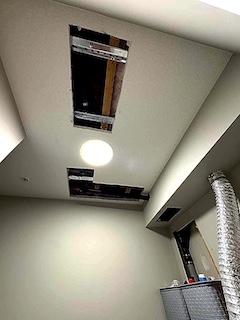
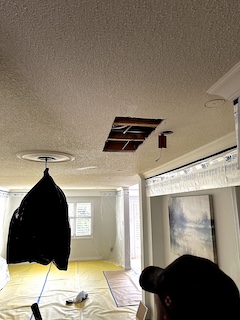
Field Photos
What the Work Can Look Like
Article Review
AuthorEPF Pro Services
Reviewed byEPF Pro Services
UpdatedJuly 19, 2026
Plan your drywall scope
Get a drywall quote today
Share photos, room sizes, and timing. We reply the same day with GTA drywall availability and a clearer written scope.
Quick next step