
How to Repair Large Drywall Holes Properly
2026-03-30
Guide to repairing larger drywall holes the right way, including when a simple patch fails and when replacement gives a cleaner result.
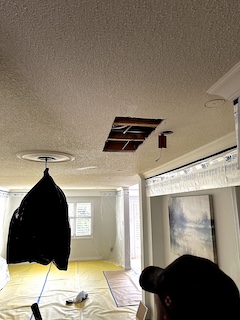
Quick Answer
Guide to repairing larger drywall holes the right way, including when a simple patch fails and when replacement gives a cleaner result.
Large drywall holes are where simple patch advice starts to break down. Once the opening is wide enough, the real issue is no longer filling a surface. It is rebuilding a solid section of wall that can be finished flat enough to disappear after paint.
If the area is in a visible room, came from a trade cut-out, or needs to be fully paint-ready again, start with drywall repair service details so you can compare a quick patch against a complete repair scope.
Why large holes need a different method
A large hole usually means the drywall edges are broken, the opening needs backing, or the surrounding area has already been weakened. That is why larger repairs often look bulky when someone tries to treat them like a nail hole or a shallow dent.
The better method is usually to square the opening, tie the repair into solid drywall, install new board, tape the seams, and finish the wall wide enough that the patch line does not telegraph through paint.
Where large holes usually come from
- Plumbing access
- Electrical changes and pot-light work
- HVAC openings
- Door-handle and furniture impacts
- Water damage that softens the board
- Old repairs that have cracked back out
Patch or replace?
If the opening is big enough that the patch has no meaningful support, replacement is usually the cleaner answer. That does not mean replacing the whole wall. It means cutting back to a stable shape, rebuilding one section properly, and finishing it so the repaired area does not read as a separate panel after paint.
What a proper large-hole repair includes
- Cleaning up the edges and removing weak drywall
- Adding backing or tying the repair into framing
- Installing a new drywall piece that sits flush
- Taping and coating the seams in stages
- Sanding and widening the finish until the repair blends out
- Priming so the surface can be checked honestly before paint
Why finish quality matters so much
A large repair can be structurally solid and still look poor if the finishing is rushed. Thick edges, narrow feathering, sanding ridges, and patch shrink-back are what make many repaired walls obvious later. The size of the hole matters, but the finish process is what decides whether the wall still looks damaged after the paint dries.
That is why high-visibility repairs often need seamless drywall repair rather than a basic patch package.
Ceilings and stair walls are less forgiving
Large holes in ceilings, upper stair walls, and open-concept rooms are harder because light travels across the surface. Even a decent repair can show if it is not widened and checked carefully before primer. These are usually the rooms where homeowners regret trying to save money with a fast patch.
When to stop calling it DIY
If the repair needs backing, new board, matching texture, or several finish coats to blend cleanly, you are already past the point where the wall is just being filled. At that stage, the main value is not speed. It is getting the wall back to a flat, durable, paint-ready condition.
If the opening came from trades, water, or repeated cracking, our professional drywall repair process is usually the safer answer than trying to hide the damage under a surface patch.
Final thoughts
Large drywall holes usually need more than filler. They need support, a flush replacement, careful taping, and finish work that blends out beyond the damaged area. The bigger the opening and the more visible the wall, the more the repair method matters.
Related local pages
How to patch drywall — The broader homeowner guide to patching methods for small, medium, and larger holes.
DIY drywall repair vs hiring a professional — How to decide whether a larger repair is still reasonable to handle yourself.
FAQ
Can a large drywall hole be patched without replacing drywall?
Sometimes, but many larger holes look better and last longer when the damaged section is cut out and replaced with a supported new piece instead of covered with a surface patch.
Why do large drywall repairs crack later?
Cracks usually come from weak backing, loose edges, heavy filler, or a repair that was not taped and finished in a way that ties into solid drywall.
Are ceiling holes repaired the same way as wall holes?
The basic idea is similar, but ceilings are less forgiving because light shows every ridge and low spot. That usually means wider finish work and stricter surface checks.
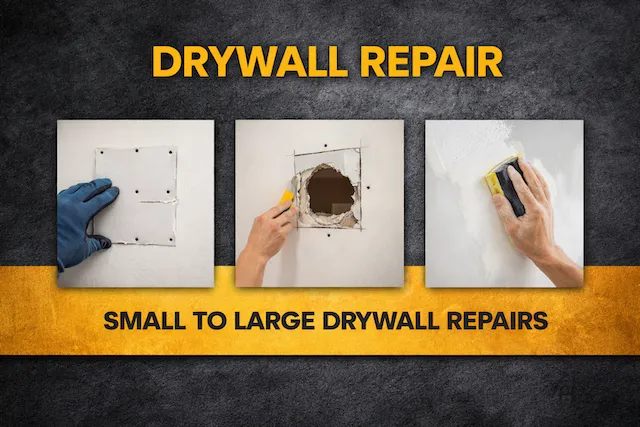
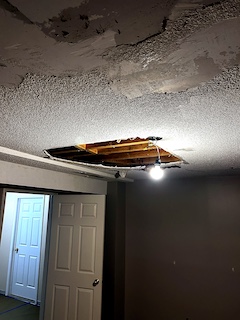
Field photos
Inspiration for your project

Drywall terms this page covers
Useful terms to compare scopes, finish levels, and scheduling before you book.
- how to repair large drywall holes
- large drywall hole repair
- repair bigger holes in drywall
- replace damaged drywall section
- patch vs replace drywall hole
- drywall repair after plumbing
- drywall repair
Article Review
AuthorAlex - EPF Pro Services
Reviewed byEPF Pro Services
UpdatedMarch 30, 2026
Plan your drywall scope
Get a drywall quote today
Share photos, room sizes, and timing. We reply the same day with GTA drywall availability and a clearer written scope.
• Clear finish-level scope and drywall sequencing
• Basements, ceilings, condos, and commercial buildouts
• Flexible scheduling for occupied homes, condos, and active sites
Quick next step
Send photos and room sizes through the main quote page, or call for a same-day reply.
Keeping the form on the main quote page helps this article stay lighter and faster.