
Drywall Repair vs Replacement: Which One Do You Really Need?
2026-04-09
Homeowner guide to deciding when drywall can be repaired, when replacement makes more sense, and how to avoid wasting money on the wrong scope.

A lot of homeowners ask the same question once wall or ceiling damage becomes obvious: can this be repaired, or does the drywall need to be replaced? It sounds like a simple choice, but most frustration in this category comes from choosing the wrong scope too early. People try to save a wall that should have been opened up, or they assume replacement is necessary when a proper repair would have solved the problem cleanly for less disruption.
The reason this decision matters so much is that drywall work is not judged only by whether the hole is covered. It is judged by whether the wall stays stable, whether the repair still shows after paint, whether the problem returns, and whether the room feels fully finished again once normal light hits the surface. That is why drywall repair vs replacement is really a decision about outcome, not only about materials.
If you want to compare your wall or ceiling against a full repair scope first, start with our drywall repair page. It covers holes, cracks, water damage, ceilings, trade cut-outs, and paint-ready wall repairs across the GTA.
This article is meant to help homeowners choose the right path before they waste time on a patch that will not last or overreact to damage that could have been repaired more simply.
Why homeowners get this decision wrong
Most people do not misjudge drywall because they are careless. They misjudge it because the visible damage is only part of the story. A small crack can point to a weak joint underneath. A bubbled painted area may look like a cosmetic issue but actually trace back to moisture. A large hole may feel dramatic while still being very repairable. The surface alone does not always tell you which route is smarter.
Another reason the decision gets muddled is that homeowners tend to think in extremes. Either the wall needs a tiny patch or the whole room needs to be torn out. In reality, many projects sit in the middle. One section may need to be cut out and rebuilt while the rest of the wall stays intact. A ceiling may need replacement in one damaged area but only repair and refinishing around it. Good drywall decisions are usually based on how far the actual problem extends, not on how alarming the first visible spot looks.
That is also why cheap advice often leads to weak results. When the goal becomes covering damage as quickly as possible, the real cause and the true repair boundary get ignored. The wall may look improved for a short time, but the finish fails again because the underlying scope was never addressed properly.
When drywall repair is usually enough
Drywall repair is usually enough when the board is still solid, dry, and well attached, and when the damage is limited to a manageable area. This can include doorknob holes, trade cut-outs, localized dents, minor cracks, screw pops, seam touch-ups, and many damaged spots where the surrounding drywall is still healthy.
The key idea is stability. If the wall surface is damaged but the drywall itself is still structurally sound, a repair is often the cleaner answer. That can mean patching a cut-out, rebuilding a section around a hole, widening a crack repair, correcting a seam, or restoring a visibly damaged area so it blends back into the rest of the wall.
This is where a lot of homeowners underestimate what a real repair can do. They hear repair and imagine a tiny cosmetic patch. But professional repair often includes opening the area properly, securing backing when needed, replacing a limited section, finishing it wide enough to disappear after paint, and making the room look calm again without disturbing more wall than necessary.
Repair is also usually the right answer when the damage is isolated but visible. A large hole in one spot does not automatically mean the whole wall needs replacement. If the rest of the wall is solid and the repair can be widened and finished properly, replacement would often create more disruption without giving you a better practical outcome.
When drywall replacement makes more sense
Replacement makes more sense when the board itself is no longer trustworthy. That usually means the drywall is soft, swollen, crumbling, repeatedly stained, mold-affected, badly broken across a wide area, or damaged in a way that makes spot repair unreliable. In those cases, the problem is not only at the surface. The material has already lost too much stability to justify treating it like a simple repair.
Water damage is the clearest example. If drywall has been wet enough to soften, sag, swell, or lose its paper face, leaving it in place often creates more risk than value. Even if the area can be made to look better temporarily, the board may still be weak or may keep telegraphing damage later. Replacement is usually the safer answer when moisture has compromised the material itself.
Replacement can also make more sense when a wall has been cut up in multiple places, when previous bad repairs have stacked too heavily over time, or when a ceiling area has enough damage that rebuilding one clean section is more reliable than trying to keep stitching together failing spots. The question is not whether replacement sounds more serious. The question is whether the surface left behind is stable enough to earn a repair at all.
Damage type matters more than the word “hole” or “crack”
Homeowners often describe drywall problems using one visible symptom: hole, crack, stain, bubble, dent, seam, or patch line. Those labels are useful, but they do not decide the scope by themselves. A small crack near a door corner can be a straightforward repair. A similar crack that keeps reopening through each season may need a more deliberate rebuild. A hole from a doorknob is different from a hole caused by plumbing access. A stain from an old leak is different from an actively soft ceiling spot.
That is why the better question is always what kind of damage this really is. Is it impact damage, moisture damage, trade access damage, movement-related cracking, failed patching, or repeated finish failure? Once you understand the type of problem, the repair-versus-replacement decision becomes much clearer.
This also explains why two walls with similar-looking damage can need completely different solutions. One may need only a clean localized repair. The other may need part of the wall opened wider because the visible damage is only the edge of the real problem.
Large holes do not always mean full replacement
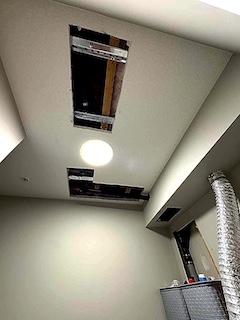
Large holes create unnecessary panic for a lot of homeowners. A big opening can look like proof that the wall is beyond repair, especially when insulation, framing, or pipes are visible behind it. But large holes are often still repair jobs, not replacement jobs, as long as the surrounding drywall is stable and the opening can be rebuilt properly.
What matters with large holes is shape, edge condition, surrounding damage, and whether the wall around the opening is still strong. A large but clean trade cut-out can often be repaired very successfully. A smaller hole surrounded by crumbling paper, water-softened board, and several failed older patches may actually be the better candidate for replacement.
That is why square footage of visible damage is only one factor. The wall condition around the damage is usually more important than the size alone.
Water-damaged drywall often changes the answer
Moisture is where drywall decisions become less forgiving. Drywall and repeated water exposure do not coexist well. If an area has staining only and the board remains dry, hard, and stable, repair may still be enough after the cause is addressed. But once the drywall is soft, swollen, sagging, crumbling, or giving off a musty smell, replacement usually becomes the smarter route.
Homeowners lose money here when they try to save damaged board for cosmetic reasons. A stain-blocked patch can make a room look better for a while, but if the material underneath is weak, the ceiling or wall is still carrying damage forward into the finished room.
The key principle is simple: if the drywall is only discolored, you evaluate it carefully. If the drywall has lost integrity, you stop treating it like a finish issue and deal with it as a replacement issue.
Ceilings are less forgiving than walls
Ceilings often push the answer closer to replacement or broader repair because gravity, lighting, and visibility all work against weak drywall. A wall patch can sometimes survive with a little more tolerance if it is in a low-visibility area. A ceiling patch or soft damaged ceiling section usually cannot hide as easily, and failure overhead becomes much more obvious.
This does not mean every ceiling issue needs replacement. It does mean ceilings deserve a stricter standard. If the board is compromised, if the repair boundary is too narrow, or if the surface will sit under strong daylight or room lighting, the finish has much less room for error. That is why ceiling work often needs a stronger scope than homeowners expect.
Previous bad repairs can make replacement more practical
Sometimes the drywall itself is not the original problem. The original problem is layers of weak repair work. Repeated filling, overly thick patching, soft tape lines, uneven patches, poorly supported cut-outs, and rushed finish work can leave a wall so inconsistent that one more patch becomes the wrong answer even if the current damage looks limited.
In those situations, replacement of the affected section can actually be cleaner and more efficient than trying to rescue every old mistake. That is especially true when the wall needs to be truly paint-ready afterward. A wall full of old patch history rarely behaves like a fresh, stable surface until the bad layers are removed from the equation.
Homeowners often frame this as repair being cheaper and replacement being expensive. But if the surface already contains years of weak work, replacement of one bad section may be the more economical path to a wall that finally stops showing its history through paint.
How to judge the wall before deciding
A practical way to evaluate drywall is to ask five direct questions.
- Is the drywall still hard and stable, or does it feel soft, swollen, or loose?
- Is the damage isolated, or does it continue past the visible area?
- Did the damage come from impact, moisture, movement, or repeated bad repairs?
- Is this a high-visibility wall or ceiling where the finish really matters?
- If this area is patched, is there a good reason to believe it will stay sound afterward?
If the answers point toward solid board, limited damage, and a stable surrounding area, repair is usually still in play. If the answers point toward compromised board, broader hidden damage, or repeated failure, replacement usually becomes easier to justify.
Why finish quality matters in the decision
Homeowners sometimes separate structural scope from finish quality, but drywall does not work that way in real rooms. A repair can be technically correct and still disappoint if it remains visible after paint. Replacement can be structurally appropriate and still look poor if the finish work is weak. The final wall has to be sound and visually calm.
This matters because some people choose repair only because they think it sounds less invasive, even when the room is one where a visible patch will bother them every day. Others choose replacement because they hope it guarantees invisibility, when the real issue is actually how the repaired or replaced area will be finished afterward.
The better decision is the one that gives you both stability and a believable finished surface. That usually means thinking beyond the opening itself and asking what the room should look like once it is painted again.
Repair vs replacement is also a disruption decision
Drywall scope affects more than budget. It affects dust, access, room downtime, painting, trim protection, and how much of the room has to be reset afterward. A good repair can preserve more of the existing room and reduce disruption if the problem is truly limited. A smart replacement can reduce repeat disruption if the existing board is too far gone to justify saving.
This is where false economy shows up. A small-scope patch may feel convenient until it fails and forces the room to be reopened later. On the other hand, opening a much larger area than necessary can create extra work that never improved the outcome. The right call is usually the scope that solves the problem once, with the least unnecessary disturbance around it.
Common situations and the usual better answer
- Doorknob hole in an otherwise solid wall: usually repair
- Electrical or plumbing cut-out with stable surrounding drywall: usually repair
- Repeated ceiling staining with softened board: usually replacement of the affected section
- Hairline crack that keeps returning in the same place: broader repair, and sometimes partial rebuild if the joint is failing
- Large visible wall area with several bad older patches: often partial replacement is more practical than another surface patch
- Water-softened bathroom or basement drywall: replacement is usually safer than cosmetic repair
What homeowners usually regret later
The most common regret is not replacement itself or repair itself. It is choosing a smaller scope than the problem deserved. That is what leads to recurring cracks, visible patch lines, bubbling paint that comes back, or ceilings that still look questionable once the room is finished. The second most common regret is assuming the most dramatic-sounding solution must be the right one and replacing more than needed without improving the finished look.
Good drywall decisions feel balanced in hindsight. The wall is opened only as far as it needs to be. The damaged or unstable material is dealt with honestly. The finish is handled with enough care that the room does not keep advertising where the problem used to be.
How to think about cost without making a bad scope choice
Cost matters, but it should follow the correct scope rather than decide it blindly. Repair is often less expensive when the board is still sound. Replacement usually costs more because it adds cut-out work, disposal, reboarding, and broader finishing. But cheaper is not better if the wall is being saved past the point where it makes sense.
A smart homeowner question is not just which option is cheaper today. It is which option avoids paying twice. If a repair has a strong chance of failing because the board is weak or the damage extends farther than the surface suggests, then the lower starting price may not be the lower outcome.
FAQ
Can large drywall holes be repaired without replacing the whole wall? Yes, often they can, as long as the surrounding drywall is still solid and the opening can be rebuilt properly.
When should drywall be replaced instead of repaired? Usually when the board is soft, swollen, mold-affected, repeatedly stained, crumbling, or damaged broadly enough that spot repair is unreliable.
Does water-damaged drywall always need replacement? Not always, but once the board loses integrity, replacement is usually the safer option.
Are ceilings more likely to need replacement than walls? They often need a stricter standard because soft areas, sagging, and visible finish problems are less forgiving overhead.
Can bad old patches make replacement more practical? Yes. If the wall has too much weak repair history, replacing the affected section can be cleaner than layering another patch over it.
Is drywall repair usually cheaper than replacement? Often yes, but only when the existing drywall is still solid enough to justify saving.
Does replacement guarantee a better finish? Not by itself. The final look still depends on how well the repaired or replaced area is finished for paint.
Final thought
The best drywall decision is not the smallest possible repair and it is not the biggest possible tear-out. It is the scope that matches the real condition of the wall or ceiling, fixes the cause honestly, and leaves the room looking calm again once paint is back on.
EPF Pro Services handles drywall repairs with that full-finish mindset, so homeowners are not left choosing between a weak patch and unnecessary replacement.
FAQ
Can a large drywall hole be repaired without replacing the whole wall?
Yes. Large holes are often still repair jobs if the surrounding drywall is solid and the opening can be rebuilt properly.
When should drywall be replaced instead of repaired?
Replacement usually makes more sense when the drywall is soft, swollen, crumbling, repeatedly stained, or broadly compromised rather than just surface-damaged.
Does water-damaged drywall always need replacement?
Not always, but once the board has lost integrity, replacement is usually the safer and more durable option.
Can previous bad patches make replacement the better choice?
Yes. When old repairs are too layered, uneven, or unstable, replacing the affected section can be cleaner than trying to patch over weak work again.
Is drywall repair cheaper than replacement?
Often yes, but only when the existing drywall is still solid enough to justify saving. A cheaper repair is not a better value if it has to be redone later.
Does replacement automatically mean the wall will look better after paint?
No. The final result still depends on how well the repaired or replaced section is finished and blended before painting.
Field photos
Inspiration for your project

Drywall terms this page covers
Useful terms to compare scopes, finish levels, and scheduling before you book.
- drywall repair vs replacement
- should drywall be repaired or replaced
- when to replace drywall
- when drywall repair is enough
- repair drywall or replace drywall
- professional drywall repair
- wall and ceiling repair
- water damaged drywall repair or replace
- large drywall hole repair
- drywall repair
Plan your drywall scope
Get a drywall quote today
Share photos, room sizes, and timing. We reply the same day with GTA drywall availability and a clearer written scope.
• Clear finish-level scope and drywall sequencing
• Basements, ceilings, condos, and commercial buildouts
• Flexible scheduling for occupied homes, condos, and active sites
Quick next step
Send photos and room sizes through the main quote page, or call for a same-day reply.
Keeping the form on the main quote page helps this article stay lighter and faster.